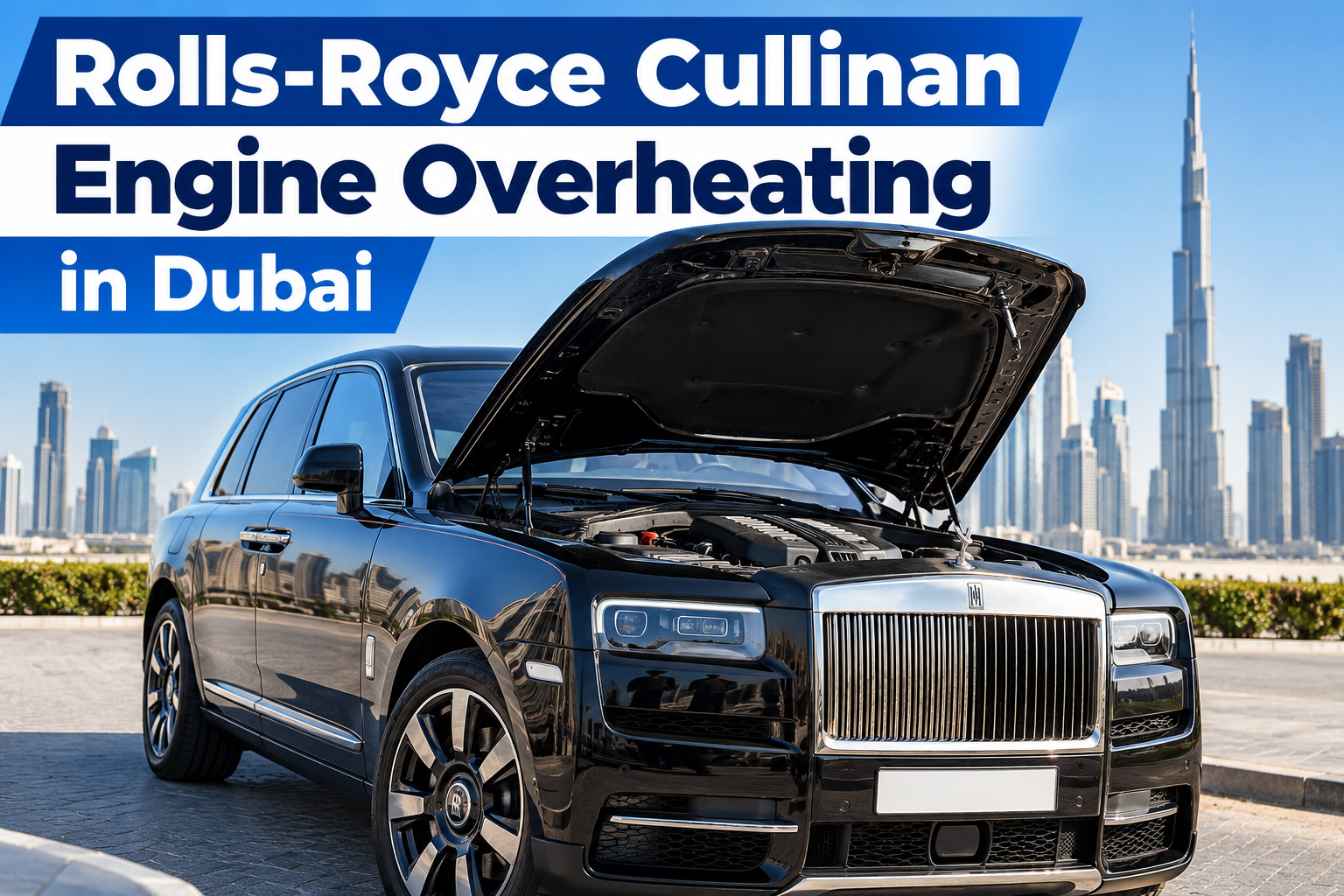
Quick Answer: A Rolls-Royce Cullinan overheats in Dubai when something inside one of its two coolant circuits stops working properly. The usual culprits are a failing electric coolant pump, air trapped after an earlier repair, the wrong or diluted coolant, a slow leak, or a radiator stack packed with fine sand. The V12 is engineered for Gulf heat, so an “Engine too hot” message is a fault warning, not normal behaviour. If it appears: ease off the throttle, switch the AC off, park safely, never top up with plain water, and do not keep driving on a red warning. Have the car recovered on a flatbed and booked in for a pressure test and live-data diagnosis. Carmend in Al Quoz offers free pickup and drop-off across Dubai.
If your Rolls-Royce Cullinan engine is overheating in Dubai, the first thing to know is that the car itself is rarely the problem. The 6.75-litre twin-turbo V12 was developed with hot-climate testing in mind. When temperatures climb on a Cullinan, a component has usually failed, a repair was done incorrectly, or the cooling system has been contaminated over time. This guide explains what is actually going wrong, how to spot it early, and what a proper repair involves.
What Is Cullinan Engine Overheating?
Overheating means the engine is producing more heat than the cooling system can remove. On a Cullinan, that is more complicated than a single radiator and thermostat.
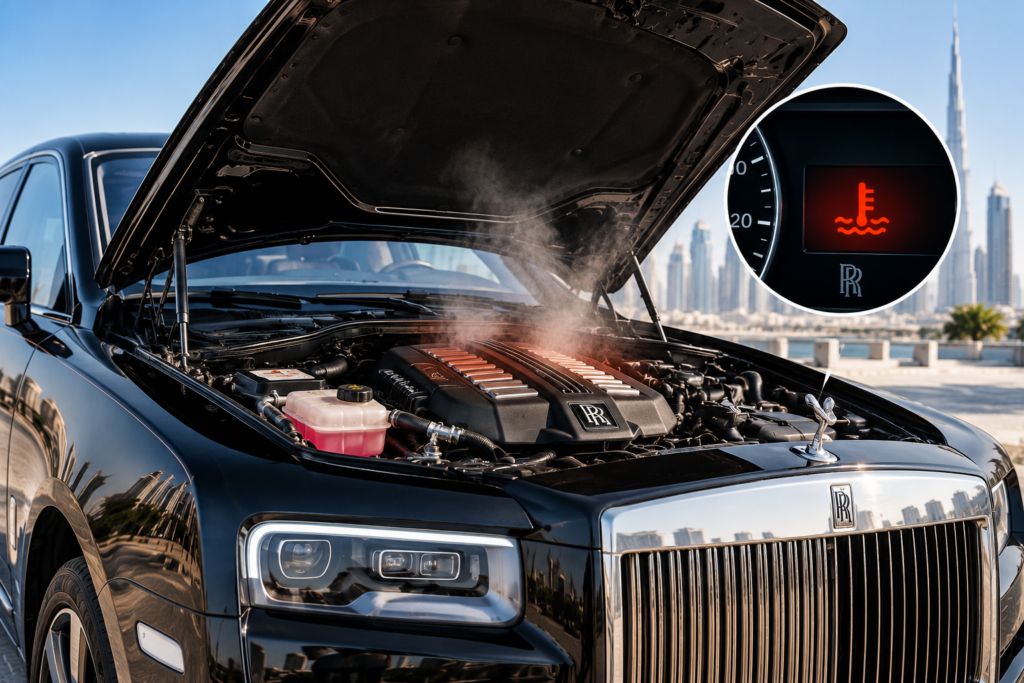
The V12 uses two separate coolant circuits. The main engine circuit cools the block, cylinder heads and turbochargers. A second, low-temperature circuit cools the air leaving the turbos before it enters the engine, and it also looks after key electronics. Electric pumps support both circuits, including an after-run pump that keeps coolant moving through the turbos after you switch off.
Because the engine management reacts early, most owners never see a needle climb into the red. Instead, the car protects itself in stages: weaker air conditioning, reduced power, then a warning message. That is why subtle symptoms matter so much.
Why Cullinan Overheating Matters in Dubai
Dubai summers push every cooling system to its limit. Ambient temperatures above 45°C reduce how much heat the radiators can shed, and slow traffic on Sheikh Zayed Road or Al Khail Road cuts airflow through the grille just when the engine needs it most. A 2.6-tonne SUV with 563 bhp (higher in the Black Badge) generates a huge amount of heat in those conditions.
Add fine desert dust, long idling with the AC running, and occasional towing or soft-sand driving, and a small weakness becomes a visible fault quickly. Ignoring it is expensive. Continued driving on a hot engine can damage the turbochargers, cylinder head gaskets and electronics, turning a pump replacement into an engine-level repair.
Key Benefits of Fixing Overheating Early
- Avoids turbocharger damage caused by heat-soaked bearings
- Prevents head gasket and cylinder head problems
- Restores full power, because the car stops cutting output to protect itself
- Brings back strong AC performance in traffic
- Protects resale value, since a documented cooling history matters to Rolls-Royce buyers
- Saves a much larger repair bill later
Common Causes of Rolls-Royce Cullinan Overheating
| Symptom | Most Likely Cause | What a Specialist Does |
|---|---|---|
| “Engine too hot” or reduced power on hot days | Weak charge-air pump or blocked low-temperature circuit | Reads live temperatures, commands the pump, vents the circuit |
| Gurgling or boiling sounds after parking | Failing turbo after-run pump | Tests pump operation after shutdown, replaces with genuine part |
| Repeated low-coolant warnings | Slow leak or faulty level sensor | Cold pressure test, UV dye, tank and sensor inspection |
| Overheating right after a previous repair | Air left in the system | Vacuum fill, bleed both circuits, recheck after heat cycle |
| Overheating that returns after top-ups | Wrong or diluted coolant, internal deposits | Concentration test, full flush, radiator assessment |
| Temperature rises in traffic, AC weakens | Sand-clogged radiator stack, fan strain | Separate and clean the stack, test fan at full speed |
| Overheating at sustained high speed or on climbs | Sticking thermostat or worn water pump | Compare sensor readings, replace faulty part |
Cooling Pump Failures
The electric pumps are the most overlooked parts of the system. They are lubricated by the coolant itself, so a pump that runs dry or ages quietly can fail without any warning light. A weak pump may only show itself on a 46°C afternoon, which is why owners often describe the problem as “random”.
Coolant Problems
Using plain water, a generic coolant or an incorrect mix is one of the most common mistakes in the UAE. A quick top-up at a petrol station feels harmless, but it can leave deposits that restrict flow for years. Factory-fill coolant is long-life, so many cars go years without anyone testing its condition.
Air in the System After Repairs
The Cullinan’s pipework has several high points where air collects. If a workshop refills the system by simply pouring coolant in, pockets of air remain and overheating can follow within days. Correct bleeding needs a vacuum filler and a separate venting routine for each circuit.
Leaks and Sand
Coolant leaks on this engine family often appear at pipe joints, quick-connect fittings and the expansion tank. Underbody trays hide drips, and heat evaporates the rest. Meanwhile, sand packs between the stacked condenser and radiators, so the front looks clean while airflow through the middle is badly reduced.
Important Factors to Consider
- Model year. Earlier cars may have expansion tank or level-sensor quirks that trigger false or misleading coolant warnings.
- Coolant history. Ask whether water or non-approved coolant was ever added. Past top-ups affect today’s reliability.
- Recent work. Any job that opened the system, including AC condenser or radiator work, can introduce trapped air.
- Usage pattern. Towing, desert driving and long idling load the cooling system far more than highway cruising.
- Battery condition. The fan and electric pumps need stable voltage, so a weak battery can cause cooling problems that look mechanical.
- Parts quality. Genuine or OEM-grade pumps, hoses and coolant protect long-term reliability.
Best Practices and What To Do If Your Cullinan Overheats
If a warning appears:
- Ease off the throttle and switch the AC off to reduce load.
- Pull over safely and switch off. The fan and pumps may keep running afterwards, and that is normal.
- Do not open the expansion tank while hot. Both circuits are pressurised.
- Do not add plain water or unknown coolant. If you had to add something to reach help, tell the technician.
- Do not keep driving on a red warning. Request flatbed recovery, because a Cullinan should not be towed with its wheels on the road.
To prevent it:
- Check both coolant tanks cold every month during summer
- Test coolant concentration at every service
- Have the radiator stack cleaned from behind once a year, ideally before May
- Insist on vacuum filling after any cooling-system repair
- Keep the battery and charging system healthy
- Book a cooling check before towing trips or desert weekends
- Do not stretch oil change intervals in summer
Cooling and AC problems often overlap. If your Cullinan’s air conditioning weakens in traffic, ask for the cooling system to be checked too.
How Professional Services Help
A Cullinan cannot be fixed by guessing. A proper diagnosis starts with live data from both circuits, followed by pressure testing, pump commands and a leak search before any part is ordered. This prevents the common trap of replacing a thermostat or radiator when the real fault is a weak pump or trapped air.
Professional repair also covers the details that decide whether the fix lasts: approved coolant at the correct mix, correct bleeding, and a verified heat cycle afterwards. Owners who skip these steps often return within weeks with the same warning.
Why Choose Carmend for Rolls-Royce Cullinan Repair in Dubai
Carmend is a Dubai luxury car workshop in Al Quoz, serving Rolls-Royce, Bentley, Ferrari, Lamborghini, McLaren, Range Rover and more. For Cullinan owners, that means:
- Diagnosis before parts. We show you the data, the pressure test result and the failed component before work begins.
- Genuine and OEM-grade parts for pumps, hoses, thermostats and radiators.
- Correct cooling procedures, including vacuum filling and circuit venting.
- Transparent quotes with no surprise additions.
- Free pickup and drop-off anywhere in Dubai, so you never risk driving a hot car.
- Experience with the full range of Rolls-Royce models, including Ghost, Phantom, Wraith and Dawn.
Our Service Process
- Contact us by phone or WhatsApp and describe the warning or symptom.
- Free pickup by flatbed or driver from your home or office.
- Full cooling diagnosis with live data, pressure test and leak inspection.
- Clear quote explaining the cause and the repair options.
- Repair using genuine or OEM-grade parts and approved coolant.
- Vacuum fill, venting and heat-cycle test to confirm the fix.
- Final check, wash and free drop-off.
Frequently Asked Questions
1. Why does my Rolls-Royce Cullinan overheat in Dubai?
The heat exposes existing weaknesses. Common causes are failing electric coolant pumps, trapped air after repairs, incorrect coolant, leaks and radiators clogged with sand. The engine is designed for hot climates, so overheating points to a fault.
2. Is it normal for the fan and pumps to run after I switch the engine off?
Yes. The Cullinan runs its fan and turbo cooling pump after shutdown to remove residual heat. It becomes a concern only if the noise is unusually loud, never stops or comes with warning messages.
3. Can I keep driving if the “Engine too hot” message appears?
No. Reduce load, switch off the AC and stop safely. Continuing to drive risks damage to the turbochargers and engine. Call for flatbed recovery.
4. Can I top up my Cullinan with water in an emergency?
Avoid it. Water dilutes the coolant mix and can lead to deposits and repeat overheating. If you must add fluid to reach a workshop, tell the technician so the system can be tested and flushed.
5. Does Dubai’s summer damage the Cullinan’s cooling system faster?
Heat, dust and heavy traffic make small faults appear sooner. Regular coolant testing, annual radiator cleaning and pre-summer inspection are the best protection.
6. How long does a Cullinan cooling repair take?
A diagnosis usually takes a few hours. Simple repairs such as a pump or hose replacement can often be completed within a day, while radiator work or flushing can take longer.
7. Does Carmend offer pickup for Cullinan overheating repairs?
Yes. We provide free pickup and drop-off across Dubai, including recovery for cars that should not be driven.
Conclusion
A Rolls-Royce Cullinan is built for the Gulf, so overheating is always a message worth taking seriously. Most cases trace back to a pump, a leak, trapped air, contaminated coolant or a dusty radiator stack, and all of them are far cheaper to fix early than after the engine has been driven hot. Knowing the warning signs, avoiding water top-ups and booking a proper diagnosis protects both the V12 and your resale value.
Call to Action
Seeing an “Engine too hot” warning, reduced power or repeated coolant alerts on your Cullinan? Do not wait for the heat to do more damage. Call Carmend at +971 55 976 9901 or send us a WhatsApp message to request a quote and arrange free pickup. Our Al Quoz team will diagnose the cause, explain it clearly and get your Cullinan running cool again.